What is allocation drift?
Allocation drift is the gap that opens between a portfolio's target mix and its actual mix as prices move.
Allocation drift is the difference between the mix a portfolio was meant to have and the mix it has now. It builds up quietly because markets rarely move in step.
How drift happens
Suppose a household writes down a target split between equity, debt, gold and cash. On the day it is set, the portfolio matches it. Over the following months, one group rises faster than another. The faster-growing group becomes a larger share of the total, and the others shrink in proportion. Nothing was bought or sold, yet the mix has changed.
New money also causes drift. If every monthly investment goes into one kind of fund, that group grows relative to the rest even in a flat market. Withdrawals do the same in reverse.
Why people track it
A target split is usually chosen to match a goal, a timeline and a comfort level with price swings. As the actual mix moves away from the target, the portfolio starts behaving differently from what was intended. Measuring drift shows how large that gap has become, so it can be discussed on facts instead of impressions.
Drift is a measurement, not an instruction
Seeing drift does not by itself say what to do. Some households set a band, such as allowing each group to wander a little either side of its target before reviewing. Others review on a fixed date each year. Costs and personal circumstances also matter, and those vary from person to person.
How Mandala shows this
Where a household has an Investment Policy Statement, Mandala stores the target split for each asset group. The Allocation tab and the comparison panel then compare the current look-through split with that target and show, group by group, how far above or below it sits. The comparison updates as prices and holdings change, and saved snapshots let you see how the gap has moved over time.
Reading a drift view
- Find the group with the largest gap from its target.
- Note whether the gap came from price moves or from new money.
- Compare with an earlier snapshot to see whether it is growing or shrinking.
The point of the view is clarity. What to do about a gap is a decision for the household and its adviser.
See it live in Mandala
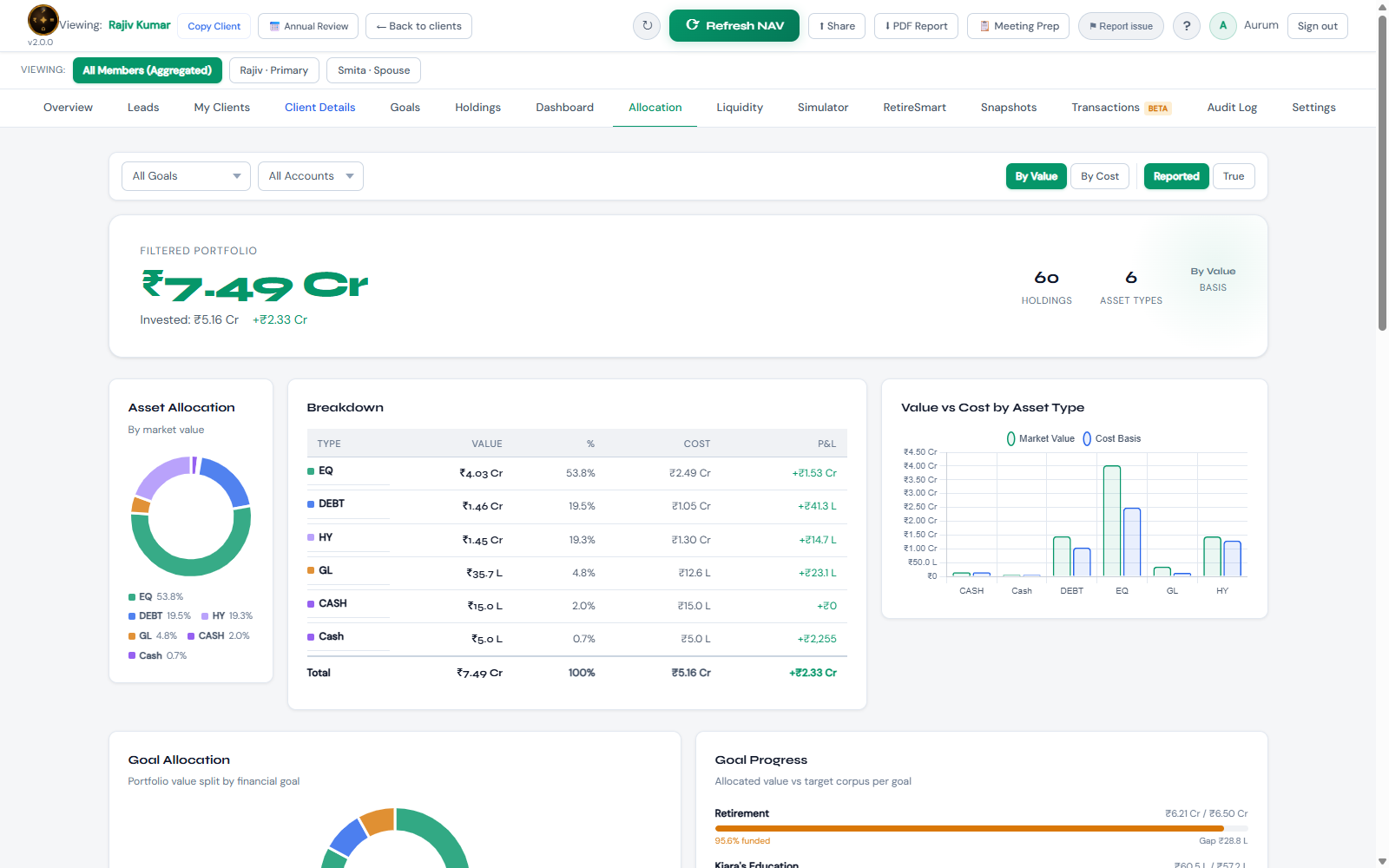 The Allocation tab in Mandala. Demo data, for illustration only.
Related reads
Educational content only, not investment advice. Examples are illustrative, and nothing here is a recommendation to buy, sell or hold any product. Investments are subject to market risks.